Karma – Consequences in Action by Stephen Canning
Karma is often described simply as cause and effect, but spiritually it goes far deeper than that. Every thought, word, and action sets something in motion — not just in our outer life, but in our inner life as well. In every tradition, karma is really about consequences: how our choices shape our present reality and our future unfolding.
Christianity expresses this principle in the well-known verse: “Whatever a man sows, that he will also reap.”
Buddhism teaches that actions leave “imprints” on the mind that ripen later. Across cultures, the message is the same: your life is shaped by the seeds you plant — knowingly or unknowingly.
In Sant Mat philosophy, this universal law is described with great clarity through three categories of karma: Sanchit, Prarabdh, and Kriyaman. Together they explain why we are born where we are, why certain events unfold, and why spiritual growth is ultimately a journey of unwinding and rising above the karmic web
- Sanchit Karma — The Accumulated Storehouse of Karmas
Sanchit karma is like the entire field of seeds we have sown throughout countless lifetimes.
Nothing is lost; every moment of intention, every action, every thought leaves a subtle impression on the soul.
- This karma is dormant, not yet ready to manifest.
- It is vast, stretching back over many incarnations.
- It forms the reservoir from which the karmas of any given lifetime are selected.
Sanchit karma are the library of your past experiences — everything you’ve ever done or caused, waiting quietly in storage.
In other spiritual traditions:
- Buddhism refers to this as the karmic storehouse consciousness (alaya vijnana).
- In Christianity, it echoes the idea that God “remembers the heart and deeds,” even across a lifetime.
-
Prarabdh Karma — The Karma Playing Out Now
Prarabdh karma is the slice of Sanchit that ripens and becomes your current life’s circumstances.
It includes:
- The family you are born into
- Your body, health, and temperament
- Major relationships
- Turning points
- Opportunities and challenges
- The general blueprint of your life
This is the karma that has already “sprouted.” It is in motion, and according to Sant Mat, it must be lived out — like an arrow already released from a bow.
You cannot erase Prarabdh, but you can change the way you respond to it. A spiritual life helps you rise above its effects, even if the events themselves must unfold.
Christianity has a similar understanding:
“You will by no means get out until you have paid the last penny.”
This reflects the idea that certain debts must be settled before moving on.
 3. Kriyaman Karma — The Karma You Create Today
Kriyaman is the most important category because this is the karma you’re creating right now.
It includes:
- Your daily actions
Book cover titled “The Language of the Chakras” by Stephen Canning, focusing on body awareness and energy healing through chakras. Available via Amazon:https://www.amazon.com/dp/B0DVWDSPSM
- Your speech
- Your thoughts and attitudes
- The way you respond to life
- The intentions behind your choices
This is the only karma you truly control.
It’s the seed you’re planting in real time.
Kriyaman karma determines:
- Your future circumstances
- Future incarnations
- Whether you create more chains or loosen the ones you already carry
It is here that the principle from Christianity rings loudest:
“You reap what you sow.”
Your choices today become your experiences tomorrow.
This is also the idea behind the Buddhist teaching:
“Intention is karma.
How the Three Types of Karma Work Together
A simple way to understand it:
- Sanchit = the seeds in storage
- Prarabdh = the seeds already sprouting this lifetime
- Kriyaman = the seeds you plant today
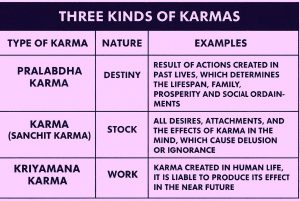
A person may have thousands of karmic seeds stored (Sanchit), only a selected bundle will be lived out this lifetime (Prarabdh), and each choice creates brand-new seeds (Kriyaman).
Karma as a Living System of Accountability
Karma is not punishment — it is education.
It’s the universe showing us the consequences of our inner state.
If we act with anger, we experience suffering.
If we act with love, we experience clarity and expansion.
Karma is life’s way of saying:
“Here is what this choice creates. Do you want more of it?”
Transcending Karma in Sant Mat
In Sant Mat, the goal is not to endlessly accumulate better karma, but to go beyond the entire karmic cycle.
How?
Through Surat Shabd Yoga, the practice of withdrawing attention inward and connecting with the inner Sound Current (Shabd). When the soul rises above the physical and subtle realms, it rises above the field where karma operates. This is the philosophy of Sant Mat. Link to Sant Mat: https://rssb.org/
Under the guidance of a true living Master:
- Sanchit karma is gradually burned away
- Kriyaman karma is purified
- The disciple learns to remain detached even while living through Prarabdh
- The soul slowly separates from the karmic machine, just as a bird rises above a storm
The ultimate goal is liberation — returning to the soul’s divine origin where karma no longer applies.
Karma as Consequences in Motion
In daily life, karma is very simple:
- Your thoughts create your mindset.
- Your words influence your relationships.
- Your actions carve out your path.
- Every choice leaves a footprint.
Karma is not “later.” Karma is now.
It’s the subtle shaping of your life moment by moment — consequences in continuous motion.
And the most empowering truth is this:
You can’t change the past, but you can absolutely change what you plant today.
And what you plant today transforms your tomorrow.
Link to other information on this website: Go Through your Karma with Grace and Ease with Mindfulness
Facebook: https://www.facebook.com/chakrawisdom/
Instagram: https://www.instagram.com/chakra_wisdom/